
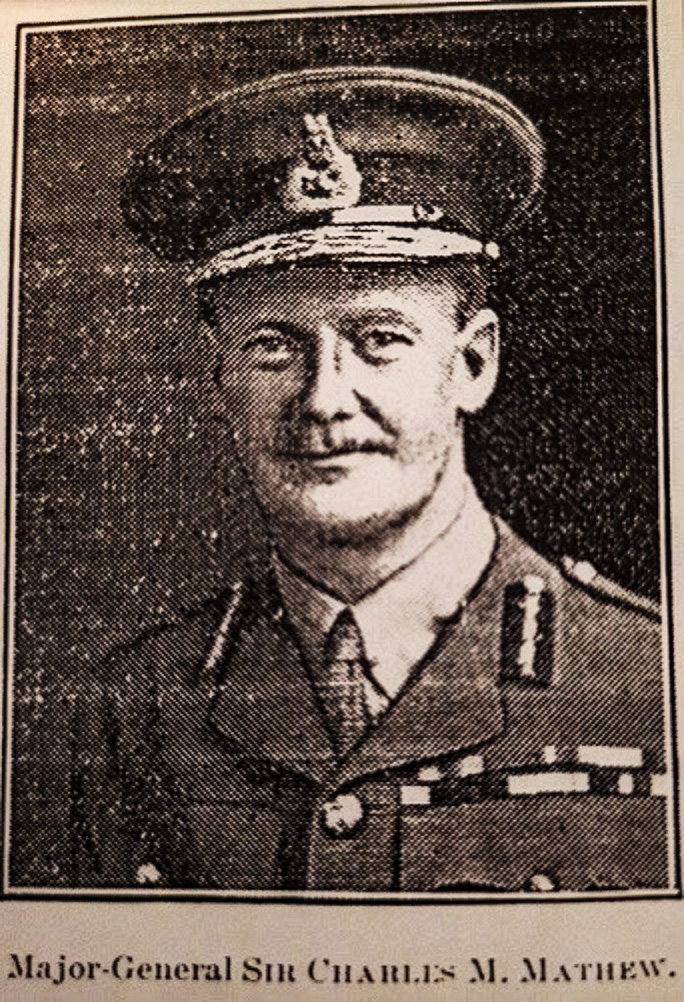
General Sir Charles Massy Mathew was a distinguished British Army officer whose military career spanned the late Victorian imperial campaigns and the First World War. Through marriage and residence, he also became closely connected with Kilbirnie and Kilbirnie Place, leaving a lasting mark on the town’s civic and social history.
Born in Wexford, Ireland, in 1866, Charles Massy Mathew was the eldest son of Surgeon-Major C. B. Mathew and Mary Mathew, daughter of Captain J. M’Call of the 4th Dragoon Guards. He was educated privately before attending Portsmouth Grammar School, setting the foundations for a lifelong military career. On 23 August 1884, he joined the 2nd Battalion of the Durham Light Infantry.
Mathew saw active service early in his career, taking part in the Sudan campaign of 1885–86 with the Frontier Field Force. He was present at the action of Ginnis and was awarded the medal with bronze star. Promotion followed steadily: he became Captain in April 1894 and soon after served in the Ashanti Expedition of 1895–96, for which he received the Ashanti Star.
In 1896, Mathew participated in the Dongola Expedition and was present at the action at Hafir. His service earned him mention in despatches and the Egyptian Medal with clasp. Two years later, during the Nile Expedition of 1898, he was present at the Battle of Khartoum, one of the defining engagements of Britain’s Sudan campaign. Again mentioned in despatches, he was awarded the Distinguished Service Order (DSO) in recognition of his conduct during the operations in the Sudan. The insignia were formally presented at a full-dress parade of the Cairo Garrison.
Following service in the South African War from 1899 to 1901, including operations in the Orange River Colony and Cape Colony, Mathew received the Queen’s South Africa Medal with three clasps. His advancement continued rapidly in the early twentieth century: Major in February 1904, Lieutenant-Colonel in January 1905, and Colonel in November 1910.
In 1910, Mathew was appointed Chief Ordnance Officer for Southern Command and became Assistant Director of Ordnance Stores. His contributions to military administration were recognised in 1911 when he was appointed a Companion of the Order of the Bath (CB).
During the First World War, he served in the European theatre, where he was twice mentioned in despatches. In August 1917, he was appointed Principal Ordnance Officer, promoted to the temporary rank of Major-General, and created a Knight Commander of the Order of St Michael and St George (KCMG), becoming General Sir Charles Mathew.
Sir Charles’s connection to Kilbirnie came through his marriage in 1904 to Janet Muir Knox, daughter of Sir James Knox of Place. Sir James Knox had commissioned Kilbirnie Place (also known as Place House) between 1892 and 1894. Designed by the Manchester architect Henry Lord, the mansion later became a prominent landmark in the town before its eventual demolition. Sir Charles and Lady Mathew resided at Place Mansion House, cementing his ties with the local community. The couple had two daughters. Lady Mathew died in 1956, while Sir Charles died in 1932.
Sir Charles played a notable ceremonial role in Kilbirnie’s civic life. On 7 October 1922, he unveiled the Kilbirnie War Memorial, an event of deep significance in the post-war years as the community commemorated those who had fallen in the Great War.
On Saturday, 9 May 1925, Kilbirnie Place Golf Club relocated to 35 acres of previously unkempt land leased at a nominal annual fee from General Sir Charles Mathew. After his death, the lease continued under Miss Martha Knox. The original nine-hole course laid out on this land still forms part of the club’s modern, expanded course. Golf was one of Sir Charles’s favourite recreations, along with shooting and lawn tennis, reflecting both his military background and his social standing.
The breadth of Sir Charles Mathew’s service was recognised nationally. His achievements were recorded in The Scotsman newspaper following his death in August 1932, and his career is detailed in the register of Distinguished Service Order recipients. Yet beyond formal honours, his legacy in Kilbirnie lies in more tangible local landmarks: the war memorial he unveiled, the grounds that supported the town’s golf club, and his association with Kilbirnie Place itself.