
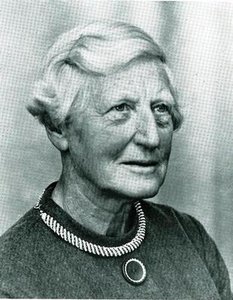
Sheina MacAlister Marshall (1896 – 1977) was a highly respected marine biologist and a world expert in plankton research. Her work was dominated by a new type of groundbreaking marine biology which focused on the ecology of the marine habitat, concentrating on marine food chains.
Jean MacAllister Marshall, known as Sheina, was born at 7pm on 20th April 1896, at 54 Kelvingrove Street, Glasgow, the second of four daughters born to parents Dr John Nairn Marshall and his wife Jean Colville Binnie, who lived at 7 Battery Place, Rothesay, Isle of Bute. Her sisters were Margaret Colville, Dorothy Nairn and Alison Binnie. Sadly, Alison died on 7th July 1905 aged eighteen months.
Sheina was educated at home by a governess until 1909, before attending Rothesay Academy and later St. Margaret’s boarding school, Polmont.
She developed an interest in zoology while helping her father, a keen amateur history enthusiast who founded the Bute Natural History Museum in Rothesay, and from reading authors such as Charles Darwin.
Sheina entered Glasgow University in 1914, but due to World War One, spent the 1915-1916 academic year working for her uncle, the metallurgist John Stewart MacArthur who owned the Loch Lomond Radium Works in Balloch, West Dunbartonshire, which used radium to illuminate clock faces and instrument dials for the British military.
Sheina returned to Glasgow University in 1916, graduating with a BSc with honours in Zoology, Botany and Physiology in 1919, and immediately won the coveted Carnegie Scholarship working with John Graham Kerr, Professor of Zoology from 1919 to 1922. Her first scientific paper, published in 1921 detailed her research on the embryo of the anteater ‘Myrmecophaga jubata’ collected from Paraguay. Her second scientific paper, published in 1922, detailed the results of her research on the structure and behaviour of ‘Hydra’ which are small carnivorous jellyfish type animals.
Upon Professor Kerr’s recommendation, she applied for a post at the Scottish Marine Biological Association’s Research Station in Millport, starting there in October 1922. Her job title was “Naturalist.” Her third scientific paper, and her first on plankton, was published in 1923 entitled “The Food of Calanus finmarchicus.”
While working on marine microplankton at Millport, Sheina discovered a new species of dinoflagellate, “Protoerythropsis vigilans,” later renamed “Nematopsides vigilans,” publishing her findings in her fourth paper in 1925, quickly followed by her fifth paper describing the microplankton found in the Firth of Clyde.
In 1923 Biochemical Assistant Andrew Orr Picken joined the Marine Biological Station to survey the physical conditions of the Clyde Sea area. The only full-time members of staff, Sheina and Andrew quickly established Millport as a major centre for plankton and other marine biological research. They investigated how both the physical and chemical conditions of the sea influenced the nature and abundance of marine organisms. In 1927 they co-authored a scientific paper entitled “The relation of plankton to some chemical and physical factors in the Clyde Sea area”.
They both joined the Great Barrier Reef expedition (May 1928 to September 1929) led by British marine biologist Dr Maurice Yonge, which studied coral reef habitats and physiology, along with the tidal process and the physical and chemical properties of the water. Of interest, one third of the expedition team were women scientists.
From 1933 Sheina and Andrew co-authored the first of thirteen scientific papers on the biology of “Calanus finmarchicus” proving its vital significance to the herring food chain in western Scotland, which later formed the basis of their book “The Biology of a Marine Copepod” published in 1955, with a second edition in 1972.
In 1934, Sheina Marshall was awarded a DSc degree (Doctor of Science) by Glasgow University. Her thesis “On the conditions influencing diatom growth in the sea” proved that her research was not limited to copepods.
Prior to the Second World War, Japan monopolized the supply of the world’s agar, used in medical laboratories to grow bacteria and make vaccines, and was “one of the first commodities to be designated a critical war material.” Sheina Marshall, Andrew Orr and two other researchers, Lillie Newton and Elsie Conway investigated the production of agar using native British seaweeds. They found that the species ‘Gigartina stellata,’ a curly dark red seaweed, also known as False Irish Moss, could be used as a substitute. Thousands of sacks of ‘Gigartina’ were gathered by teams of school children, girl guides, sea scouts and other voluntary organisations. Huge piles of ‘Gigartina’ were dried out at Millport to be processed into agar.
From 1942 to 1943 Sheina examined the effect of artificial fertilizers on Plankton in Loch Craiglin, publishing a paper in 1947 entitled “An experiment in Marine Fish Cultivation: III. The plankton of a fertilized loch.”
When the Royal Society of Edinburgh first admitted women as Fellows in 1949, Sheina MacAllister Marshall was one of the first five pioneering women to be admitted. In 1963 she was elected as a Fellow of the Royal Society of London and in 1966 she was awarded an Order of the British Empire (OBE) for services to marine science.
In 1962 she was appointed Deputy Director of the Marine Biology Station, in Millport. She retired in 1964 but continued to research marine biology, being the first Honorary Research Fellow when the universities of Glasgow and London took over the Marine Biology Station.
In 1969 the ‘Food Chain Research Group’ at Scripps Institution of Oceanography, University of California, San Diego, invited Sheina (then aged 73) to join them for a year. In 1971 she was awarded the Royal Society of Edinburgh “Neill Prize” for ‘outstanding contributions to Natural History’. In 1973 she published “Respiration and Feeding in Copepods” in the journal “Advances in Marine Biology”.
In 1974 she visited the Observatoire Oceanologique de Villefranche marine station in Villefranche-sur-Mer Marine Station in the Côte d’Azur, France; and researcher Bruce W. Frost named a species of copepod after her, known as “Calanus marshallae.”
In 1977, a few days before her death, she received news that she was to be awarded an Honorary Doctorate from the University of Uppsala, Sweden, for her outstanding academic work.
Sheina MacAlister Marshall died of a heart attack at Lady Margaret Hospital, Millport, on 7th April 1977, two weeks before her 81st birthday. She bequeathed her house at 16 Kames Bay, Millport, for the use of the Directors of the Marine Biological Station. Aside from her research interests, Sheina enjoyed walking, foreign travel, needlework, poetry and music.
The book she had begun writing before her death was edited by J. A. Allen and published in 1987, entitled “An Account of the Marine Station at Millport.” The library at the Marine Biological Station, Millport, was renamed the Sheina Marshall Room. At Dunbeg, Oban, the Sheina Marshall building was opened in 2011 at The Scottish Association for Marine Science. Her sister Dorothy left a bequest in 1992 to the University of London to establish the Sheina Marshall Memorial Fund for scholarships in marine biology at Millport. Until 2013 the Fund supported ‘Sheina Marshall PhD Scholarships’ at Millport. Following the transfer of the Marine Biology Station in Millport to the Field Studies Council in 2014, the fund now supports both undergraduate and postgraduate students who undertake marine biological courses and research at Millport.