
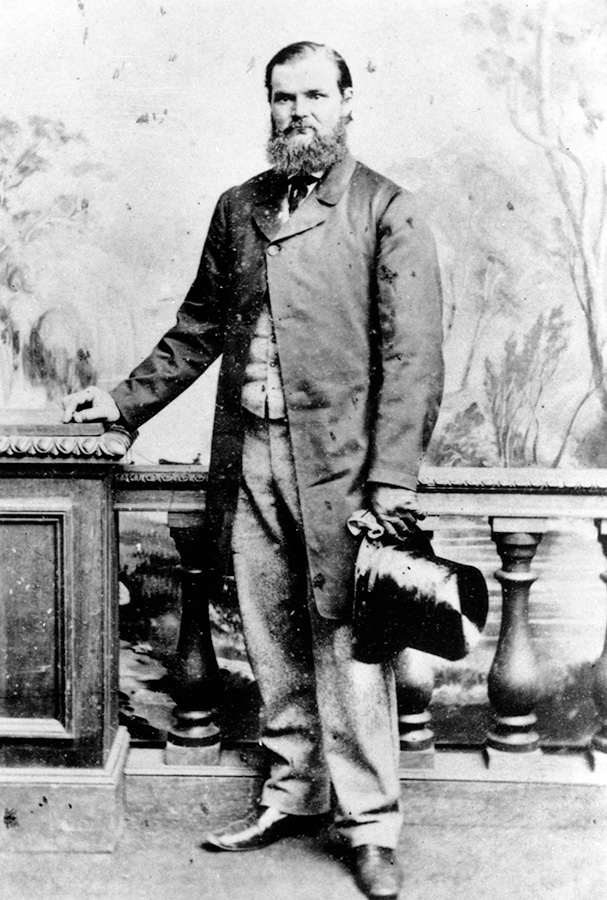
William Landsborough was born 21 February 1825 in Stevenston, the fourth child of Rev. Dr. David Landsborough and Margaret McLeish. He was baptised on 06 March 1825. He was educated in Irvine. In 1841, aged 16, he emigrated to New England, New South Wales, Australia where his older brothers John and James had sheep farming stations.
He initially made his living as a farmer while learning about the Australian outback and by 1850 had become an expert bushman. In 1851 he joined the gold rush to Bathurst where he made enough money to buy his own sheep station. He then followed his brothers to Queensland where they had a sheep station at Monduran on the Kolan River.
He explored and named Mount Nebo, New South Wales in 1856; the Broad Sound on the East Coast of Queensland in 1857; the Comet and Nogoa Rivers, Central Queensland in 1858 and the Bonar River, North Queensland in 1859. While exploring the Torrens Creek area of the Bonar River his party kept a careful eye out for any remains of an expedition led by Friedrich Leichardt which had disappeared in the bush in April 1848. Also in 1859 he began exploring the country around the Fitzroy and Belyando Rivers with Nathaniel Buchanan before heading further west. This time William Landsborough found himself in need of rescuing when his party ran out of food. In 1860 William and Nathaniel Buchanan explored the area around the Thomson River.
In 1861 William Landsborough, Nathaniel Buchanan and Edward Cornish created the Landsborough River Company. By 1863 Landsborough had sold all of his sheep stations, except for Glenprairie near Broad Sound to purchase 15,000 square miles of land near Thomson River which he named ‘Bowen Downs’ which was then mortgaged to the Scottish Australian Company Bank.
In 1861 his expertise as an explorer led him to being chosen by the Victorian and Queensland governments to lead one of four search parties for the missing expedition party which had been led by Robert O’Hara Burke and William Wills who had last been seen in December 1860.
The Queensland Burke Relief party led by Landsborough left Brisbane on 24 August 1861 for the Albert River, South East Queensland in August 1861 aboard the brig Firefly. On board the ship were the eleven members of the crew of the Firefly, the nine members of Landsborough’s relief party, 30 horses and enough food and equipment for both Landsborough’s party and that of Frederick Walker’s relief party who eventually arrived at the Albert River on 17 December 1861.
The Firefly was run aground and damaged by severe weather. After undertaking emergency repairs it was eventually towed to the Albert River by the ‘Victoria’. The Firefly entered the Albert River on 11 October, the first ship to ever do so and under strenuous conditions slowly advanced up the river. On 09 November unable to go any further they landed Landsborough’s party, the goods and horses at what was later to become known as Burketown and waited for Walker to arrive. Walker eventually arrived on 17 December with the news of a possible trace of the missing expedition.
The Landsborough relief party set out on 16 November 1861 traversing 250 miles through the desert land along the Gregory River before returning to the Burketown depot on 25 January 1862 where he heard the news about the missing expedition. He resupplied and set out again, this time initially following the Flinders River. His 1200 mile journey took him from the Gulf of Carpentaria to the Darlington River in New South Wales through dangerous terrain. On 21 May 1862 they arrived half-starved at Neilston and Williams’s station on the Warrego to find that both Burke and Wills had died. With renewed supplies they set out for Melbourne to deliver the horses and equipment.
William Landsborough was celebrated as the first Explorer to cross Australia from north to south. He made a report to the Royal Society regarding everything he had discovered enroute and was presented with an inscribed plate. When his findings of good grazing land was made public there was rush to secure new land.
In Sydney he met his Caroline Hollingworth Raine whom he married on 30 December 1862 and honeymooned in Britain. Upon his return to Australia He was appointed as Administrator for the new settlement of Burketown on the Gulf of Carpentaria. He eventually left Burketown on 24 March 1872. His wife died of tuberculosis leaving him to raise their three daughters. On 08 March 1873 he married Maria Theresa Carr with whom he had three sons.
In 1882 the Queensland Government rewarded him with £2,000 for his exploration of Queensland with which he bought a cattle station ‘Loch Lamerough’ at Caloundra. He died on 16 March 1886.