

The Haylie Neolithic Chambered Cairn in Largs is looking great. When I first arrived in Largs some four years ago it was in a sad state: overgrown, fence down and no interpretation board (there had been one but it had rotted away). What I didn’t know was that local historical enthusiast Richard Topping was on the case. And through his efforts the site has been transformed. He did of course have help from North Ayrshire Council, Historic Environment Scotland and Archaeology Scotland, plus others.
I got involved when all the work was done; clever me! I decided that it was looking so good that it should be taken under the wing of some locals to keep it smart. No big deal, just keeping the grass cut along the paths and removing litter when necessary. (As it happens there has been very little litter since the regeneration). So I initiated an informal team – The Largs Neolithic Tombsters.
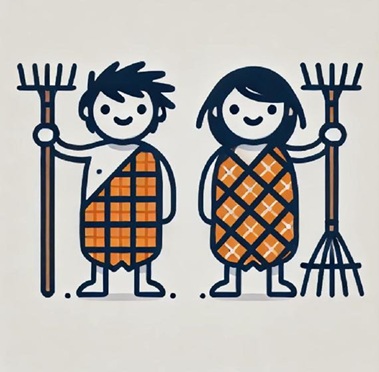
We are a small group of ‘gardeners’ who from time to time visit and do some tidying. Bye the way, the logo was produced through my first encounter with ChatGPT – ever so simple and effective.
The tomb was ‘discovered’ back in 1772 when the landowner, William Wilson, decided he wanted to build a wall on the edge of his estate. However he did have a large pile of stones near to his house – known as Margaret’s Law – so he though he would use these rather than quarrying more. So the builders gradually removed what was in fact a burial cairn and discovered the huge stones that made up the main chambers. They took what they needed and what remains is the larger stones that were no use for wall building – well at least they left us something. William Wilson also removed five or so skeletons but what happened to them is a mystery.

Fast forward to 1953 and the professional archaeologists, Aitken & Marshall, arrived and did a proper job.
They found a further two skulls, several bones, earthenware and a flint scraper. These are now kept in the national Museum of Scotland.
Then in 2004 carbon dating was carried out on a small piece of one of the skulls from 1953 and was dated as being 5,560 years old, plus or minus 20 years. Accurate enough for me!
This is pretty much what remains today: I wonder where the other two or more Cap Stones ended up?
The site is of course open to the public, and access is easy. Plus there are many paths leading up the hill onto the high ground behind providing spectacular views of the Clyde Coast and The Cumbraes. But I digress.
The new interpretation board provides lots of other detail:

But if you find the print to be too small on this then you’ll just have to visit. The Grid Reference is NS 20950 58594 and the What3Words location is ///reclining.attaching.sudden.
Or if you would like to hear about it from me in person…..
Last month I was invited to give a short talk on the Tomb, at the Tomb. My audience was a group of 12 enthusiastic amateur archaeologist from Largs. This was very well received so I intend repeating my performance – perhaps over several afternoons once Spring has arrived. I will of course publicise the talks in NA Heritage.